

The Future Energy Scenarios (FES) 2025 report lays out a comprehensive vision for how Britain’s energy system could evolve between now and 2050, with a focus on achieving net zero. Informed by expert modelling and stakeholder engagement, the scenarios serve as a strategic planning tool to guide investment and infrastructure decisions across the energy landscape. This year’s FES outlines four possible pathways, each shaped by varying levels of consumer engagement, technological deployment, and hydrogen integration. Each of the three pathways which meet net zero by 2050 rely on energy flexibility, storage, and hydrogen infrastructure. Here, Storelectric is strategically aligned with FES 2025 and positioned to deliver critical technology.
Understanding the Pathways
The Holistic Transition:
In the scenario, net zero is achieved through a balanced blend of electrification and hydrogen use. Hydrogen is concentrated in industrial clusters and heat networks but not widely adopted for domestic heating. Consumers play a major role by embracing energy efficiency, smart homes, and flexible demand through electric vehicles. This is a high-renewables scenario, with unabated gas phased out entirely by 2050. Flexibility on the supply side comes from mass deployment of large-scale electricity storage and interconnectors, supported by moderate nuclear deployment and the lowest levels of hydrogen dispatchable power of all the net zero scenarios.
Electric Engagement:
Net zero is reached through a more electricity-dominant system. Electrified demand particularly through electric heat pumps and vehicles, drives the highest peak electricity demand of all four scenarios. This pathway relies heavily on nuclear and renewables and sees the largest use of bioenergy with carbon capture. Like Holistic Transition, it depends heavily on flexible technologies like storage and interconnectors to enable low carbon dispatchable power to balance the system.
Hydrogen Evolution:
Here, net zero is met through rapid progress in hydrogen deployment, particularly for industrial processes and heating. The national hydrogen network becomes widespread, and hydrogen boilers are introduced for some homes. However, consumer engagement is comparatively low. The pathway sees reduced reliance on nuclear and renewables due to high levels of hydrogen dispatchable generation. Large scale hydrogen storage provides crucial grid flexibility.
Falling Behind:
In the fourth pathway, we do not reach net zero. It instead represents a slower decarbonisation trajectory, still making progress from today but not fast enough to fully meet 2050 targets. It models a scenario where reliance on unabated fossil fuels persists for longer, and infrastructure does not meet the needs of the energy transition.
The Role of Storage and Hydrogen
Across all three net zero-aligned pathways, the FES 2025 emphasises the absolute need for flexibility in enabling decarbonisation. The system must be capable of managing high volumes of variable renewable generation. For that, energy storage is critical.
Short-duration storage, such as batteries, will support rapid response immediate balancing needs, while long-duration energy storage (LDES) is essential for seasonal balancing.
Hydrogen, too, plays a significant role. Its use varies between pathways, from targeted industrial clusters to national-scale deployment. In each scenario, hydrogen becomes increasingly important as an energy vector for hard-to-decarbonise sectors and as a form of long-term storage.
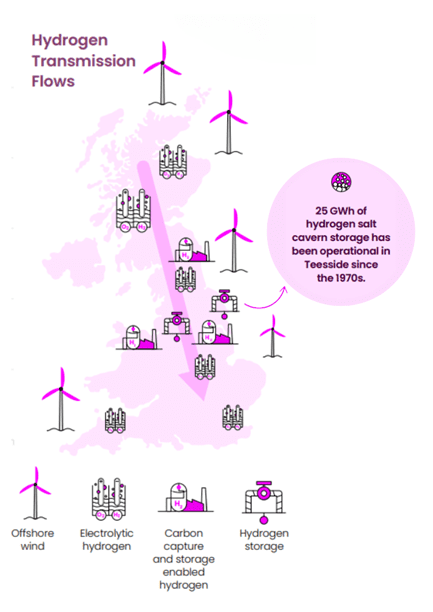
Electrolysis using surplus renewable power enables hydrogen production without emissions, while salt cavern storage is highlighted to both ensure continuity of supply during periods of low generation, and to store the massive amounts of hydrogen needed for full industrial decarbonisation
FES 2025 sees the development of a national hydrogen transport and storage network as a future necessity, since production will be concentrated in specific hubs. There will be a need to transmit hydrogen to users elsewhere.
.
Our Role in Delivering Net Zero
Storelectric’s offering aligns directly with the core needs identified in FES 2025. Our salt cavern-based technologies provide long-duration, large-scale energy storage that supports high-renewables scenarios by securing supply during low generation periods. As FES outlines, these capabilities are not optional but essential to maintaining grid resilience and decarbonising power generation.
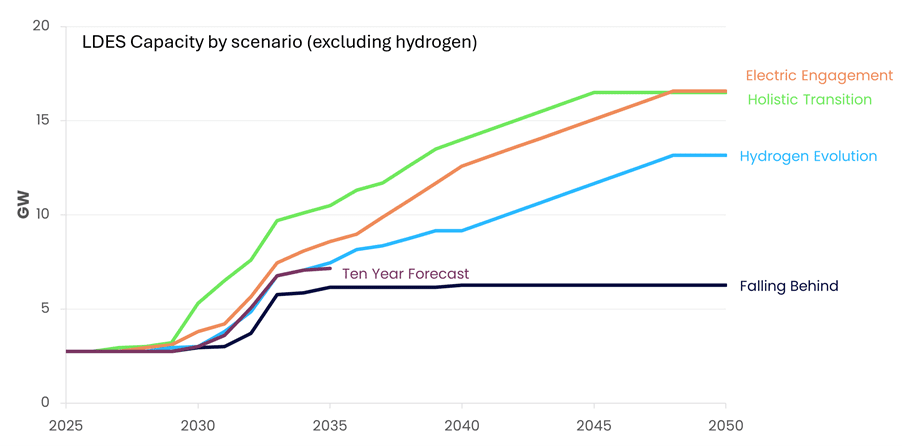
Furthermore, Storelectric’s hydrogen storage solutions are critical to realising the Hydrogen Evolution pathway and underpinning hydrogen dispatchable power in the others. Our patented technology enables massive-scale hydrogen storage within salt caverns, an infrastructure requirement highlighted repeatedly in the FES report.
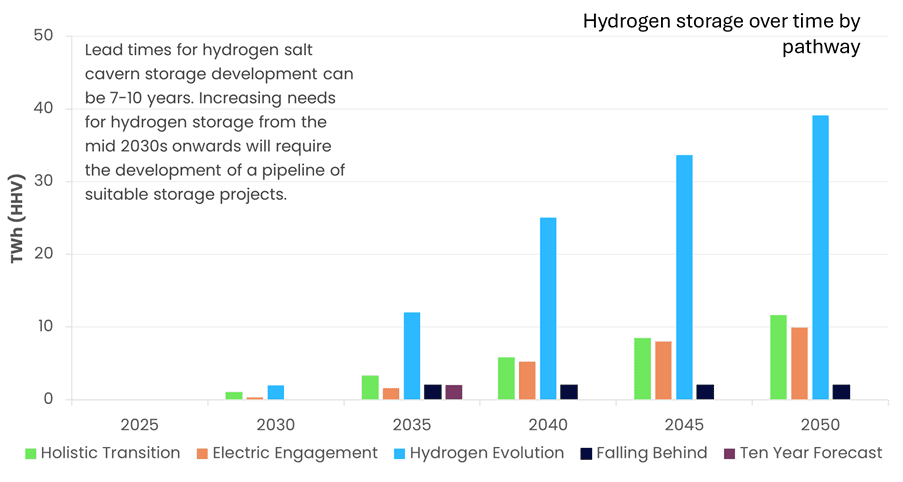
We are further aligned with FES through our integration of green hydrogen electrolysis with compressed air energy storage (CAES). Our co-located model captures the heat generated during compression and uses it to enhance electrolysis efficiency. Storelectric’s approach ensures that such surplus energy can be stored and redeployed with minimal waste, whilst making green hydrogen production and storage economically viable.
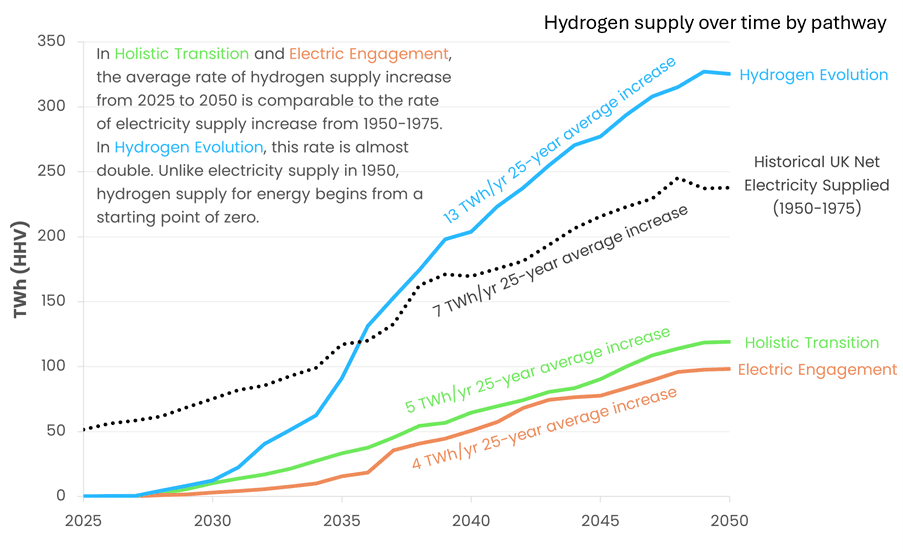
FES 2025 makes clear that the path to Net Zero is not singular; multiple routes exist. What each route shares, however, is the need for large-scale, long-duration storage and a robust hydrogen infrastructure. Storelectric’s proven, patented technology can deliver these requirements. Our geological storage model and co-located hydrogen production offers the very flexibility and resilience that FES identifies as central to a decarbonised, secure, and cost-effective energy future. Whether the UK pursues a hydrogen-led transition, a renewables-heavy system, or a combination of both, Storelectric is ready to power the transition to a greener future.


